
 Sign In
CASE STUDY ERP & Business Operations
Migrating Off Legacy ERP While the Business Keeps Running
How Platformz helps a multi-entity operating business migrate off a legacy ERP while order flow, fulfillment, and reporting keep running.
| Category | ERP & Business Operations |
|---|---|
| Engagement profile | Multi-entity operating business |
| Story type | Anonymized reference engagement narrative |
| Primary audience | Founder, CEO, COO, CTO, transformation leader |
| Core systems | Platformz orchestration services, Magento, NetSuite OneWorld, Salsify, Brandfolder, Pipe17, HubSpot, Stripe |

Executive Summary
This case study demonstrates how Platformz can migrate off a legacy ERP while order flow, fulfillment, and reporting keep running. The engagement is designed around the reality that modern commerce is not one website or one software implementation. It is a connected operating system spanning product data, finance, inventory, purchasing, orders, payments, fulfillment, retail compliance, customer service, analytics, and executive decision-making. Platformz provides the architecture, reusable integration components, delivery governance, and managed operating support needed to make those systems work as one business.

Business Challenge
The company had capable tools, but the process between them depended on people. Data ownership was unclear, status was interpreted differently by each team, and exceptions were discovered after customers, retailers, suppliers, or finance had already been affected. The central challenge was to migrate off a legacy ERP while order flow, fulfillment, and reporting keep running. The solution therefore had to improve the current operation without interrupting revenue, preserve the strengths of specialist applications, and create a foundation that could be extended rather than replaced during the next phase of growth.

Platformz Blueprint
Platformz begins with a paid Blueprint rather than a software-first recommendation. The seven customer-facing steps are Goals; Company; Products & Scale; Systems & Connections; Portals & Workspaces; Ongoing Help; and Review & Next Steps. For this engagement, the Blueprint was used to migrate off a legacy ERP while order flow, fulfillment, and reporting keep running. It defined the future-state business process, the owner of every important data object, the boundary of each system, the required portals and workspaces, the control points that needed human approval, and the ongoing administrative support needed after launch. The result was a sequenced plan that separated launch-critical capabilities from later optimization so the organization could move quickly without creating another disposable architecture.

Solution Architecture
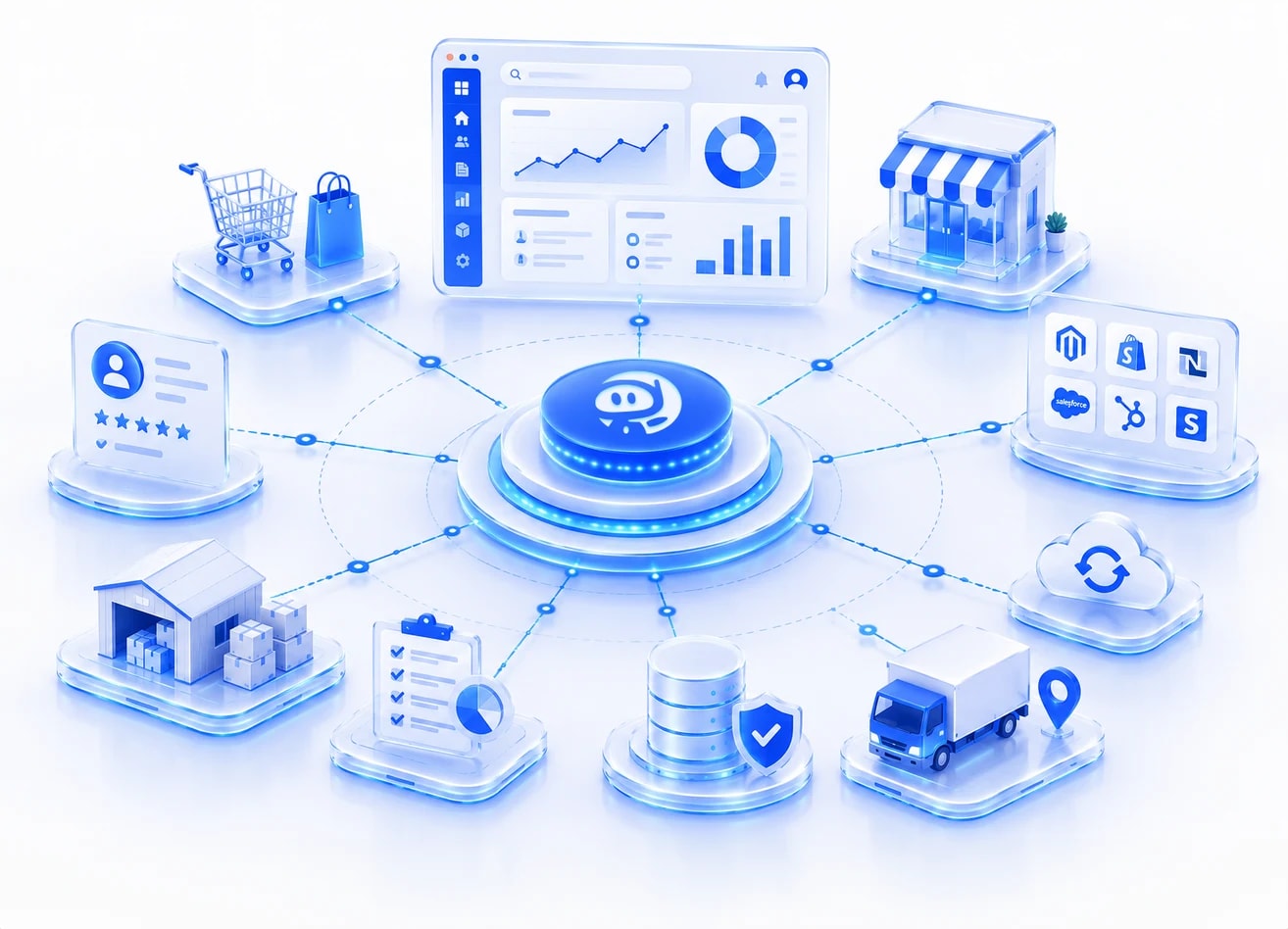
The solution used Platformz orchestration services, Magento, NetSuite OneWorld, Salsify, Brandfolder, Pipe17, HubSpot, and Stripe. Platformz did not treat these applications as isolated destinations. A shared orchestration layer coordinated identities, master data, transactions, events, exceptions, and monitoring. Systems of record remained authoritative for the data they were designed to own, while Platformz controlled movement, validation, mapping, retries, reconciliation, permissions, and operational visibility. This architecture supported the central objective: to migrate off a legacy ERP while order flow, fulfillment, and reporting keep running. Client ownership was preserved through client-controlled accounts, repositories, domains, credentials, data, documentation, and deployment assets.

Implementation Approach
Delivery followed four controlled phases: Stabilize the current process and protect active revenue; Model the data, rules, roles, and acceptance criteria; Automate the highest-value workflows with test evidence and exception handling; and Scale through additional channels, countries, facilities, products, or automation. Each release included ownership, runbooks, monitoring, rollback planning, data reconciliation, user acceptance, and operational training. Success was defined by business outcomes and control quality, not by whether an API call returned a successful response.

Key Automated Workflows
- Capture approved master data and operating rules in systems of record rather than personal spreadsheets or inboxes.
- Orchestrate work across specialist applications while preserving ownership, validation, and audit history.
- Surface exceptions instead of requiring people to inspect every normal transaction.
- Measure outcome, service level, cost, capacity, and risk using a common executive operating view.

Governance and Controls
Every automated action was tied to an owner, source record, rule version, timestamp, evidence trail, and exception path. The Looking Glass Control Tower Admin Portal provided the shared view of business health, system health, exceptions, ownership, and action status when the engagement required cross-functional visibility. This prevented automation from becoming a hidden black box and ensured that operators could understand why the system made or recommended a decision.

Business Value
The organization gains a clear operating model, a prioritized investment sequence, and an architecture that can absorb growth without repeated replacement projects. The deeper value is organizational: the business can migrate off a legacy ERP while order flow, fulfillment, and reporting keep running without transferring critical knowledge to one employee, one vendor, or one spreadsheet. For public publication, quantitative claims should be inserted only after the responsible owner approves the measurement method, baseline, time period, and supporting evidence.

Lessons and Replication Guidance
Architecture should follow the operating model. Buying applications before defining ownership and process usually moves complexity rather than removing it.
The model can be repeated by preserving the canonical data model and control framework while changing partner mappings, commercial rules, countries, channels, and workflow priorities.


